


The U.S. president also discussed tensions involving Britain, Argentina and the Falkland Islands during his diplomatic trip to Ireland.
U.S. President Donald Trump said Saturday that he would welcome the eventual reunification of Ireland, offering an unusually direct opinion on one of the island’s most sensitive political questions.
Trump made the remarks during a meeting in Dublin with Irish Prime Minister Micheál Martin. Asked about the possibility of Northern Ireland joining the Republic of Ireland, Trump said he believed a united Ireland would be a positive development.
He acknowledged, however, that the British government would have an important role in any such process.
“I don’t want to cause any problems but I’d love to see it unified,” Trump said, adding that he believed reunification would happen eventually and might as well take place sooner rather than later.
Northern Ireland’s Political Divide
The question of Irish unity remains deeply connected to Northern Ireland’s complicated history.
For decades, the region was divided between mainly Catholic nationalists, many of whom supported joining the Republic of Ireland, and largely Protestant unionists, who wanted Northern Ireland to remain part of the United Kingdom.
Those competing national identities contributed to the Troubles, a period of roughly 30 years of political violence involving paramilitary organizations, British security forces and other groups. The conflict claimed approximately 3,600 lives.
The 1998 Good Friday peace agreement, reached with significant American involvement, largely brought the violence to an end. However, it did not settle Northern Ireland’s constitutional future.
Under the agreement, a referendum on Irish unity can be held if it appears likely that a majority of voters would support reunification.
British Prime Minister Andy Burnham said earlier in the week that he was not aware of majority support for another referendum. He indicated that a vote would not be held unless public opinion changed.
Trump’s comments were notable because American presidents have generally avoided taking a direct position on the constitutional question, even when they have maintained strong personal or cultural connections to Ireland.
Trump Raises Falkland Islands Dispute
During his Ireland visit, Trump also returned to the possibility of renewed conflict between Britain and Argentina over the Falkland Islands.
Argentina, led by President Javier Milei, continues to claim sovereignty over the South Atlantic territory, which Britain administers and calls the Falkland Islands. Argentina refers to the islands as Las Malvinas.
The dispute led to war in 1982, when Argentine forces invaded the islands and Britain launched a military operation to regain control.
Trump has previously suggested that the United States might reconsider its traditional neutral position regarding the islands’ sovereignty. On Saturday, he questioned whether Britain would be able to repeat its 1982 military success if another conflict occurred.
He also joked that he might be asked to intervene in the dispute and suggested he could potentially help negotiate a settlement.
Meetings With Ireland’s Political Leaders
Trump’s schedule in Ireland included meetings with both the country’s prime minister and President Catherine Connolly.
Connolly, who serves as Ireland’s largely ceremonial head of state, previously criticized Trump and participated in protests during his 2019 visit to the country. She has also spoken strongly in support of Palestinians and has criticized aspects of U.S. policy in the Middle East.
Despite those past disagreements, Connolly welcomed Trump at Áras an Uachtaráin, her official residence in Dublin’s Phoenix Park. The two leaders shook hands and spoke briefly before entering the building.
Trump later appeared outside on his own, saluted as the Irish Defence Forces band played the U.S. national anthem and inspected an Irish Army honor guard.
He was also scheduled to meet American and Irish business representatives at the U.S. ambassador’s residence before traveling west to Doonbeg.
Dublin Residents Criticize Visit Disruptions
Trump’s visit created significant security and traffic restrictions across Dublin.
Police established a security cordon around Phoenix Park, a large public park covering approximately 1,750 acres. Additional security measures were introduced near the government guesthouse at Farmleigh and the U.S. ambassador’s residence at Deerfield.
Some Dublin residents criticized the disruption and questioned the decision to welcome Trump while global conflicts and political crises continue.
Taxi driver Christopher Fox said the president’s trip had created disorder in the city and argued that Trump appeared more interested in playing golf than addressing international problems.
University student Mina Petrovski also condemned Trump’s positions on women, immigrants and minority communities. She described the Irish government’s welcome for him as embarrassing.
A coalition of left-wing opposition groups, anti-military organizations, environmental activists and pro-Palestinian campaigners planned demonstrations in Dublin during the visit.
Eric Trump Defends Family’s Irish Connections
Eric Trump, the president’s son, defended the family’s presence in Ireland and argued that local residents appreciate the investment connected to the family’s golf resort in Doonbeg.
Speaking to Ireland’s national broadcaster, RTÉ, he said the Trump International Golf Resort was the largest employer in the surrounding area.
Eric Trump encouraged critics to speak with residents and business owners in Doonbeg about the resort’s economic contribution and the family’s relationship with the community.
His comments came as protesters prepared to demonstrate against the president’s visit.
Golf and Presidential Business Interests
Trump’s trip to Ireland continued a pattern of combining presidential travel with his private business interests and personal enthusiasm for golf.
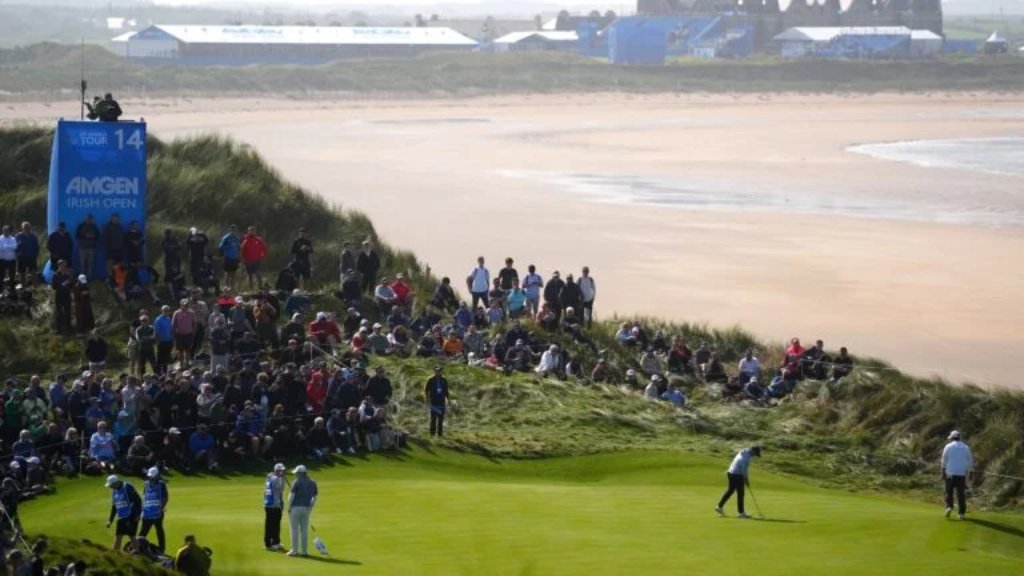
He frequently plays at golf clubs owned by his company in Florida, New Jersey and Virginia. His attendance at the Irish Open also reflected his growing presence at major sporting events, some of which take place at properties connected to his family business.
The Irish Open is the second European Tour event held at a Trump-owned golf course this year. The Nexo Championship took place at his club in Aberdeen, Scotland, the previous month.
Trump also visited Scotland the previous year, spending several days playing golf at his Turnberry resort and attending the opening of another course in Aberdeenshire. That trip included official meetings with British and European leaders.
This weekend’s visit similarly combined diplomacy, political controversy and commercial visibility, with Trump scheduled to watch the Irish Open at his Doonbeg course following his meetings in Dublin.